Research
Phase Separation
Liquid–liquid phase separation is a key mechanism driving the formation of biomolecular condensates in living cells. The formation, structure, and dynamics of these condensates are governed by a rich interplay of molecular interactions, chemical reactions, and mechanical properties. Our research aims to uncover the universal physical principles underlying phase separation and to develop strategies for controlling the spatiotemporal organization of molecules — both inside cells and in chemical engineering applications.
Size control of condensates via long-range interactions
Condensation is typically driven by short-range attractions, but many biomolecules carry charges that also mediate long-range repulsion. What happens when these two competing interactions coexist?
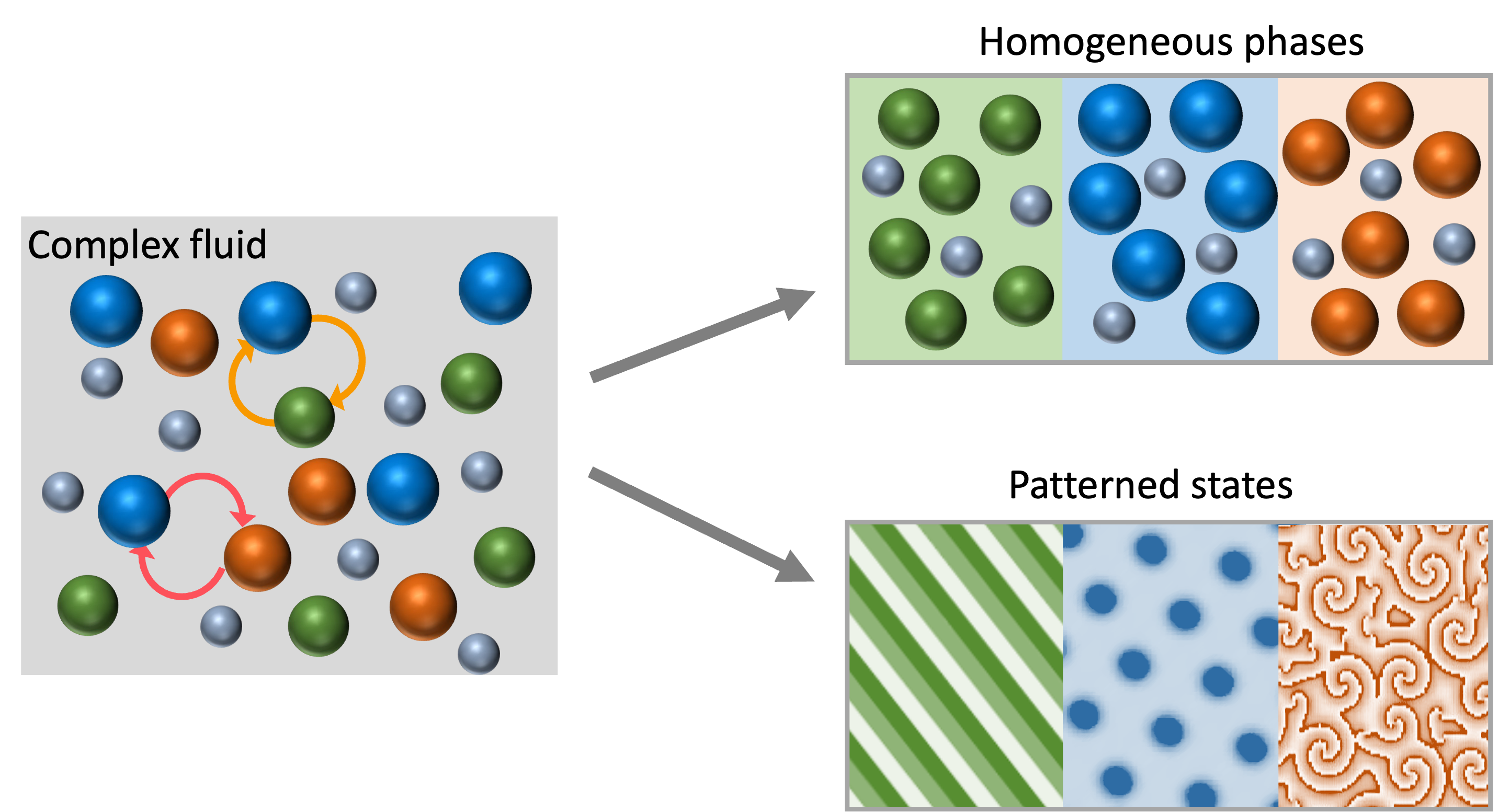
Using molecular dynamics simulations and an equilibrium field theory, we show that the interplay of short-range attraction and long-range repulsion can arrest coarsening, leading to many droplets of well-defined, equal size at equilibrium. Crucially, this size control is governed by the charge asymmetry between molecular constituents, while the strength of the short-range attractions has a weak influence.
Higher-order interactions in multicomponent phase separation
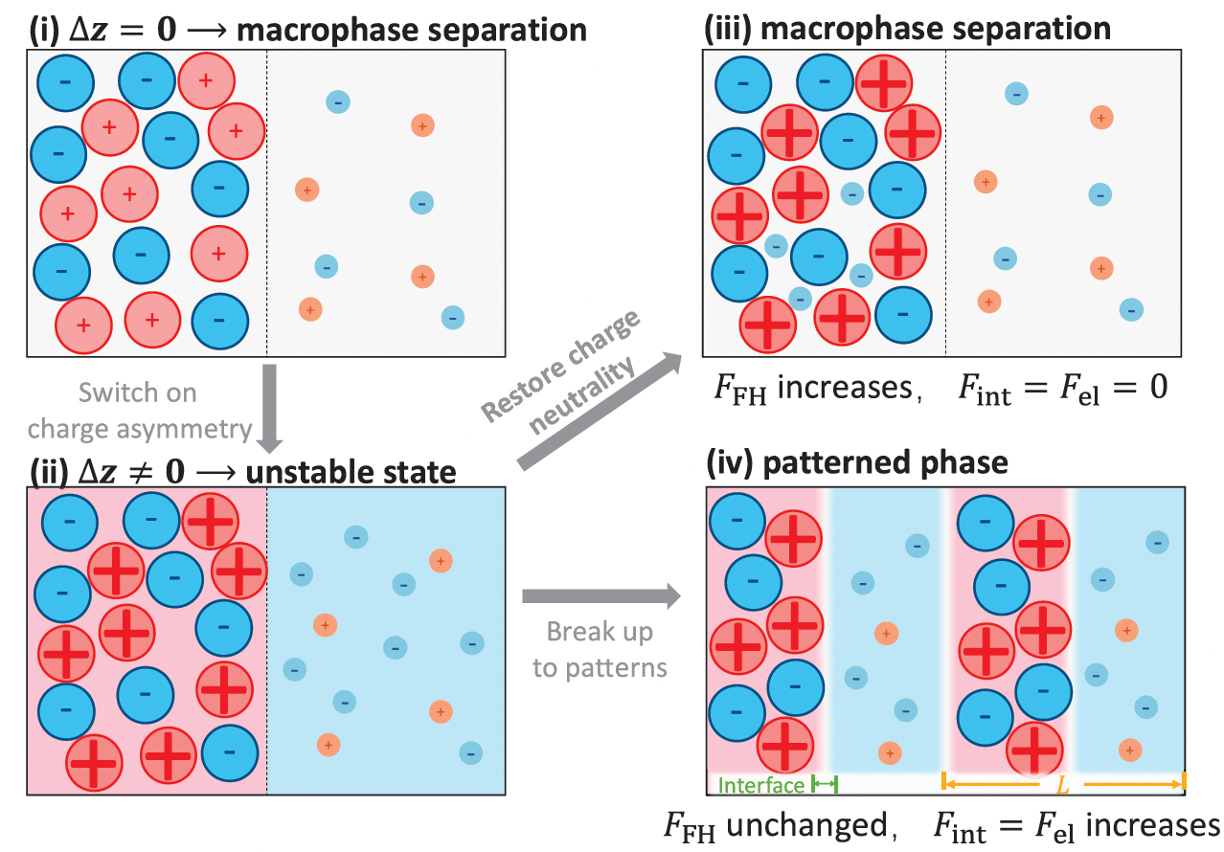
Biomolecules exhibit complex, higher-order interactions in which a single molecule can engage with multiple partners simultaneously. Moreover, cells contain a vast number of distinct molecular species that form a variety of condensates. Both features lie beyond the reach of classical mean-field theories such as Flory–Huggins theory. How do such higher-order interactions affect phase separation in multicomponent systems?
We identify two fundamentally distinct types of cubic interactions:
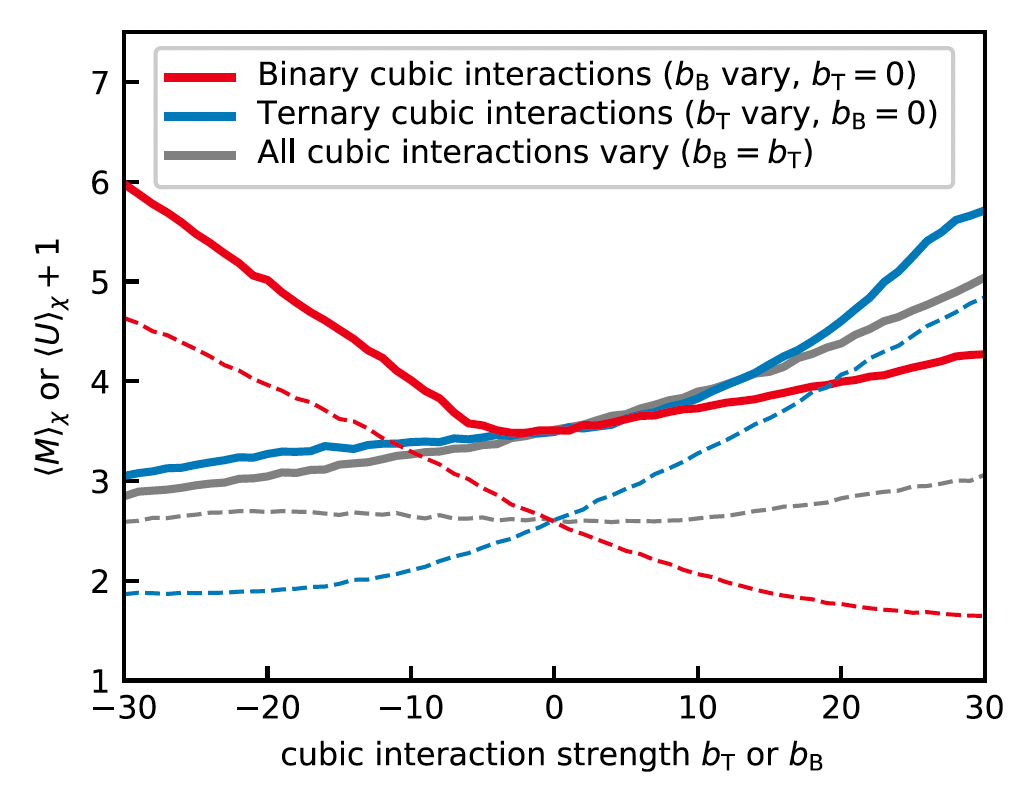
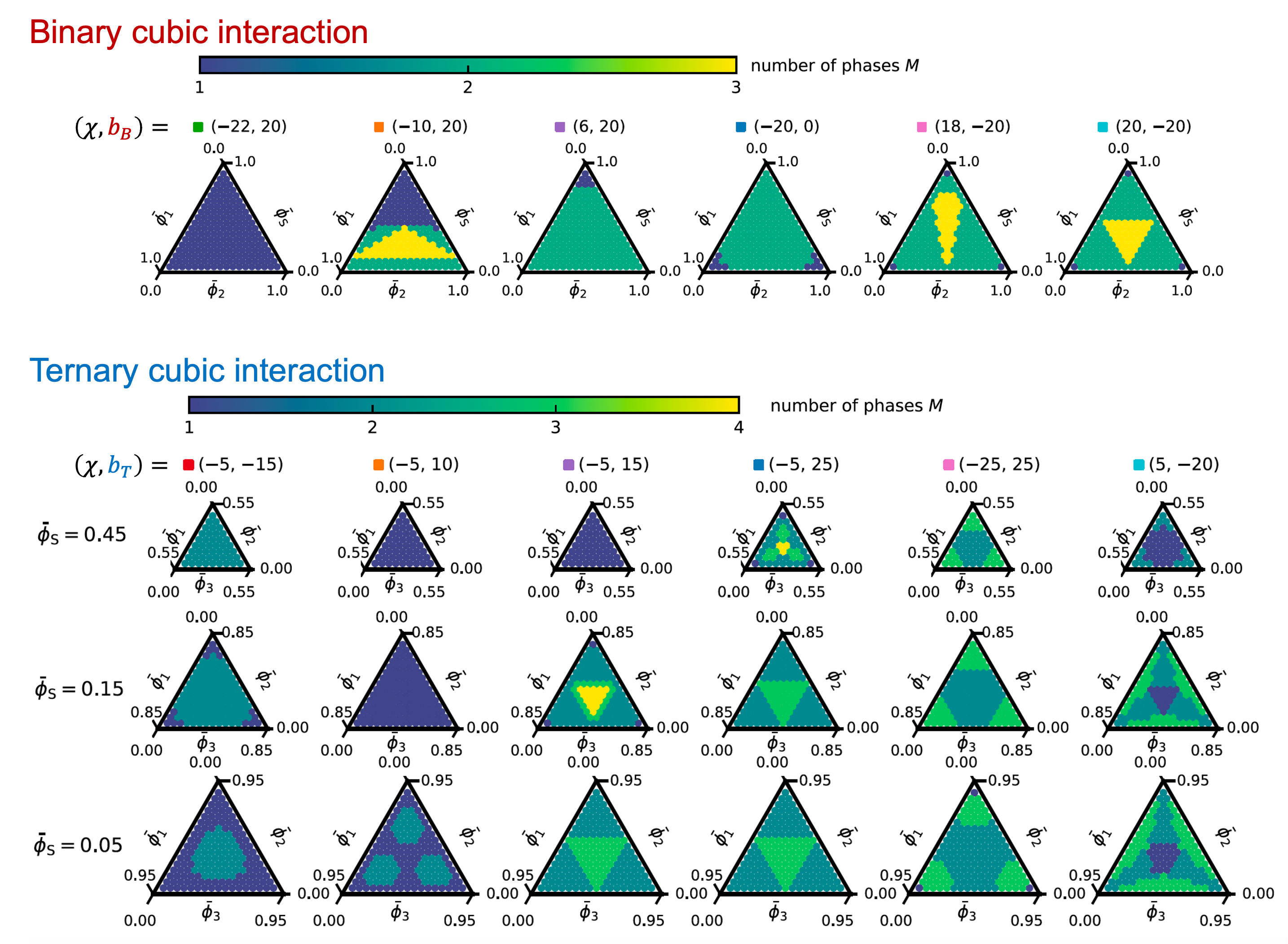
Spatiotemporal patterns from the interplay of reactions and physical interactions
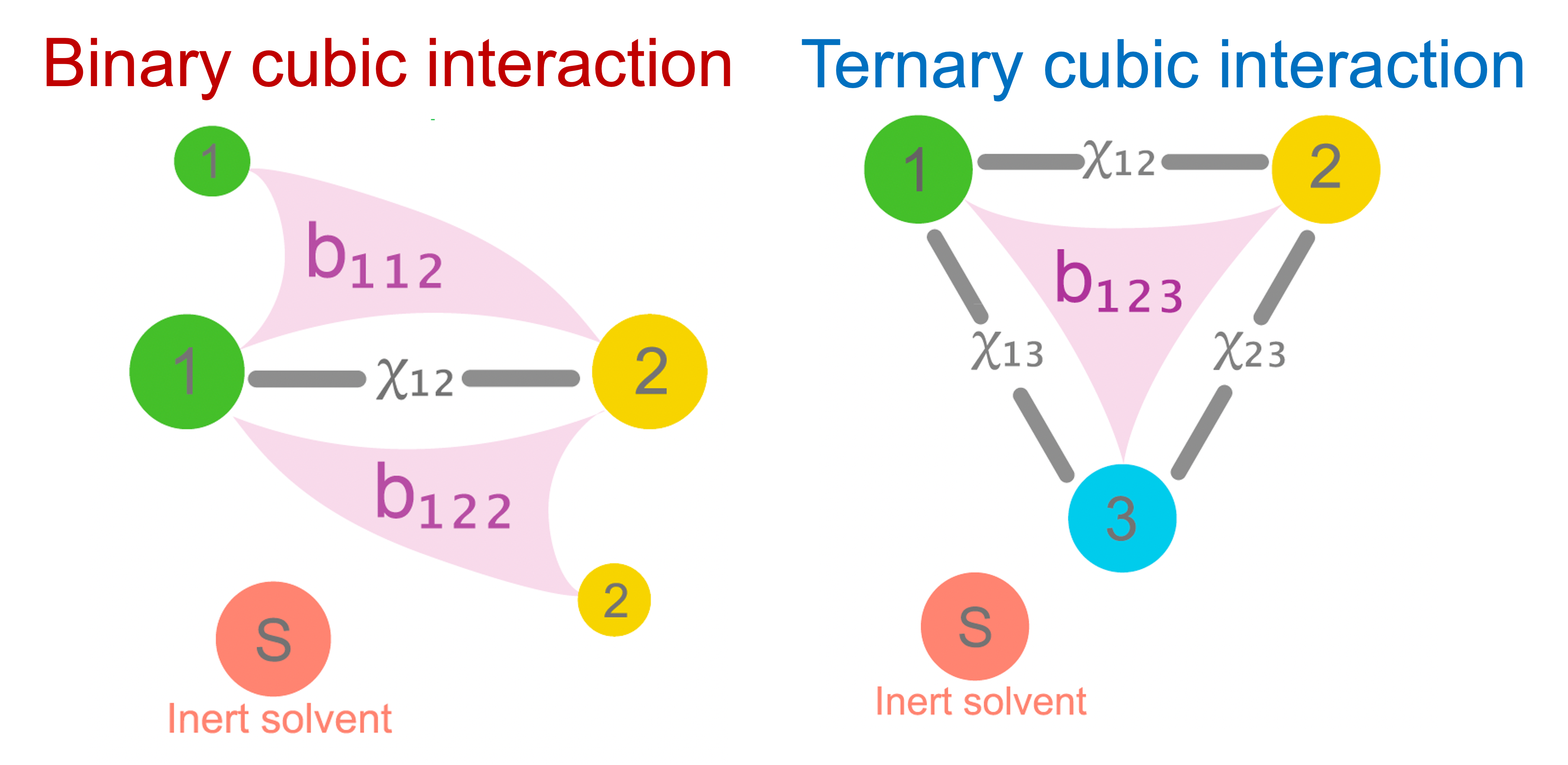
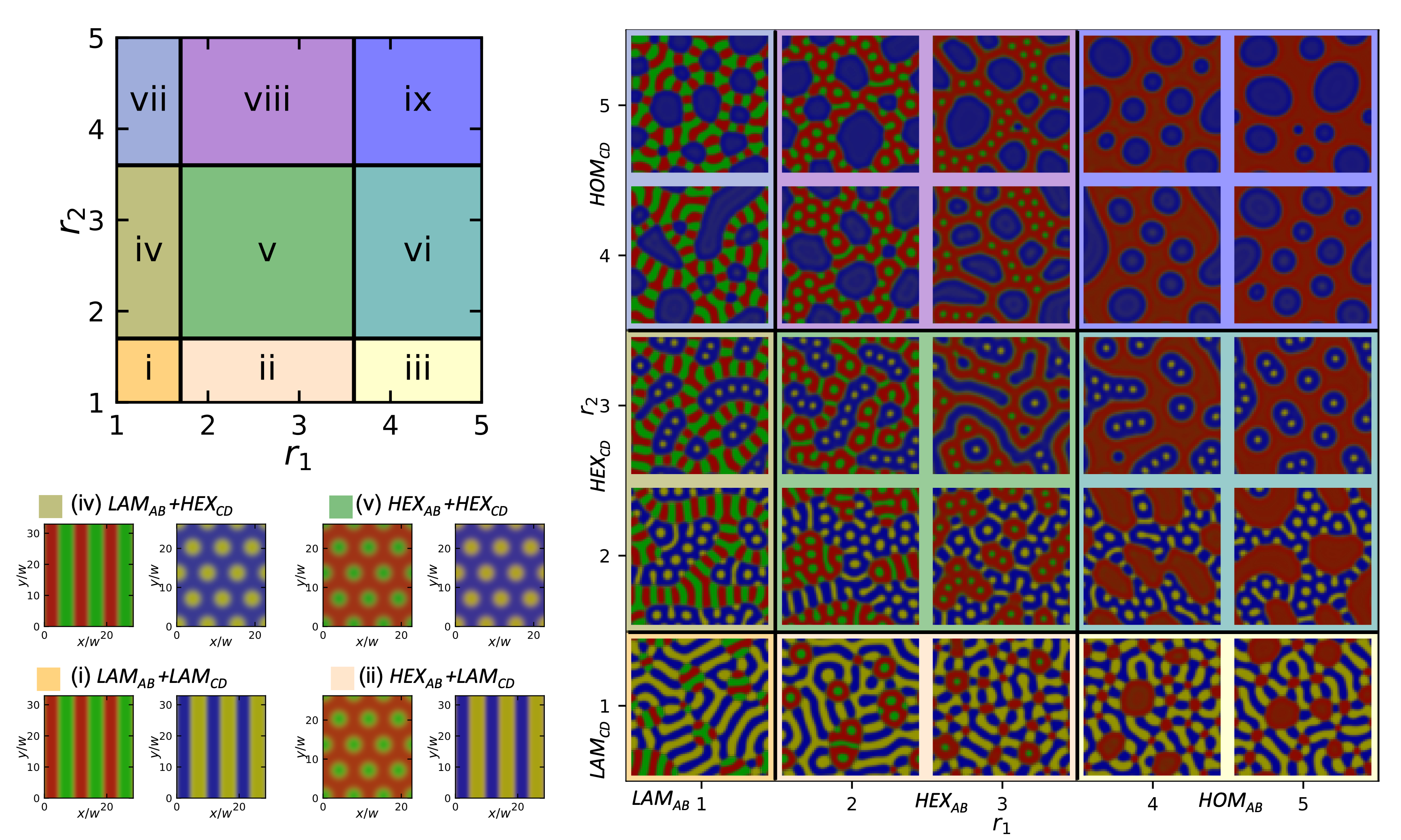
Cyclic-dominance reactions — such as the classic rock-paper-scissors game — coupled with ideal diffusion produce spiral waves. But real molecules are not ideal: they attract and repel each other. How do physical interactions reshape these spatiotemporal patterns?
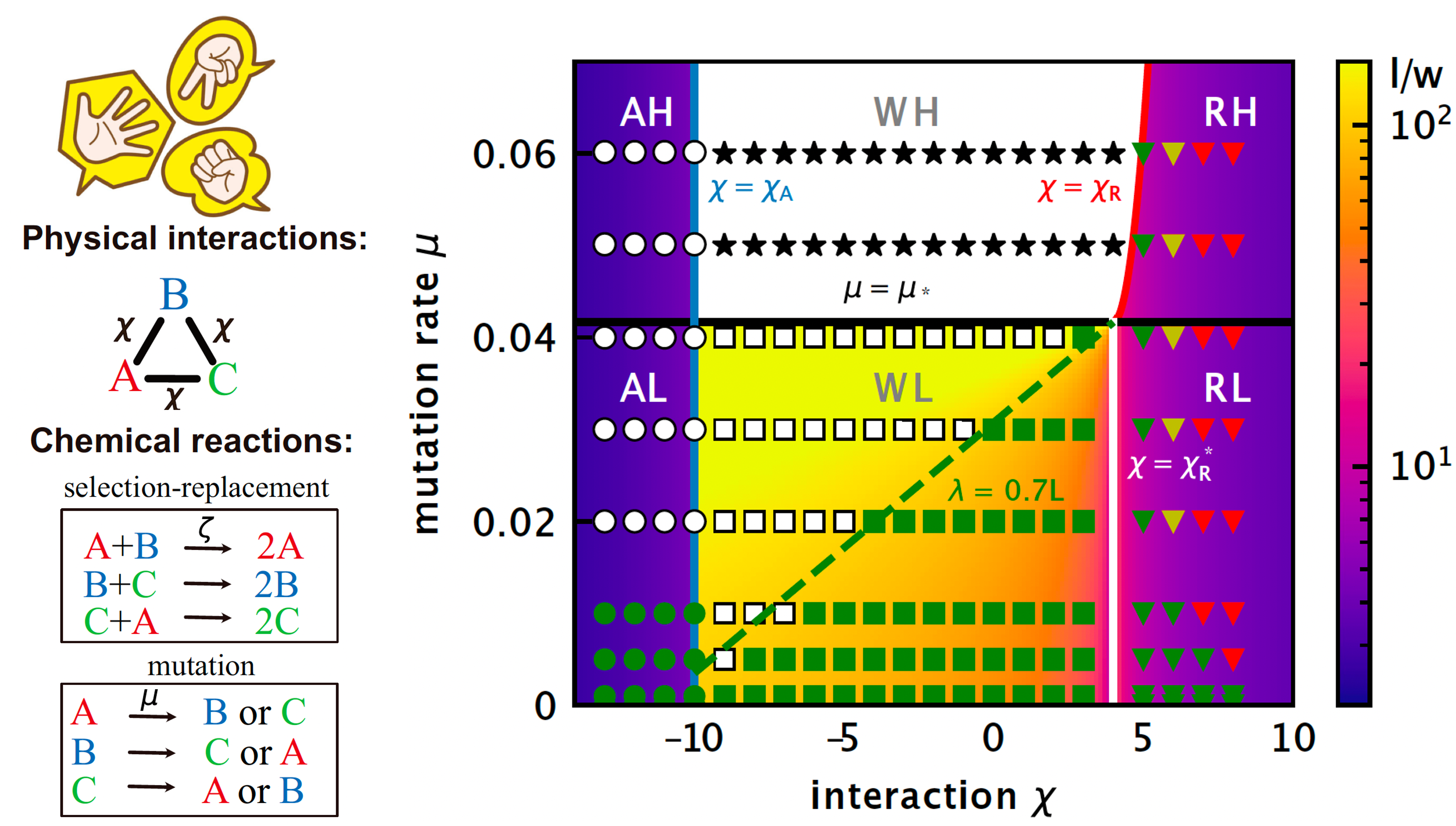
▼μ=0.05, χ=5
▼μ=0.05, χ=6
▼μ=0.05, χ=6.5
▼μ=0.03, χ=-11
▼μ=0.005, χ=-11
Coexistence of patterned phases in chemically active mixtures
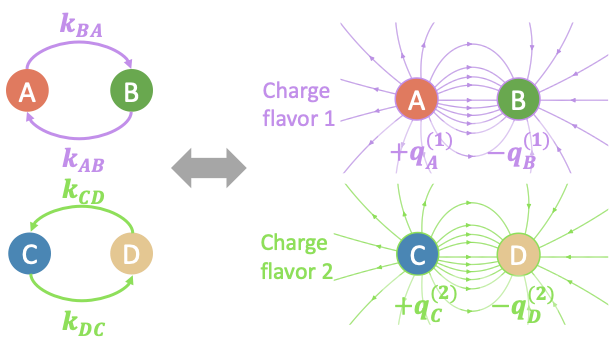
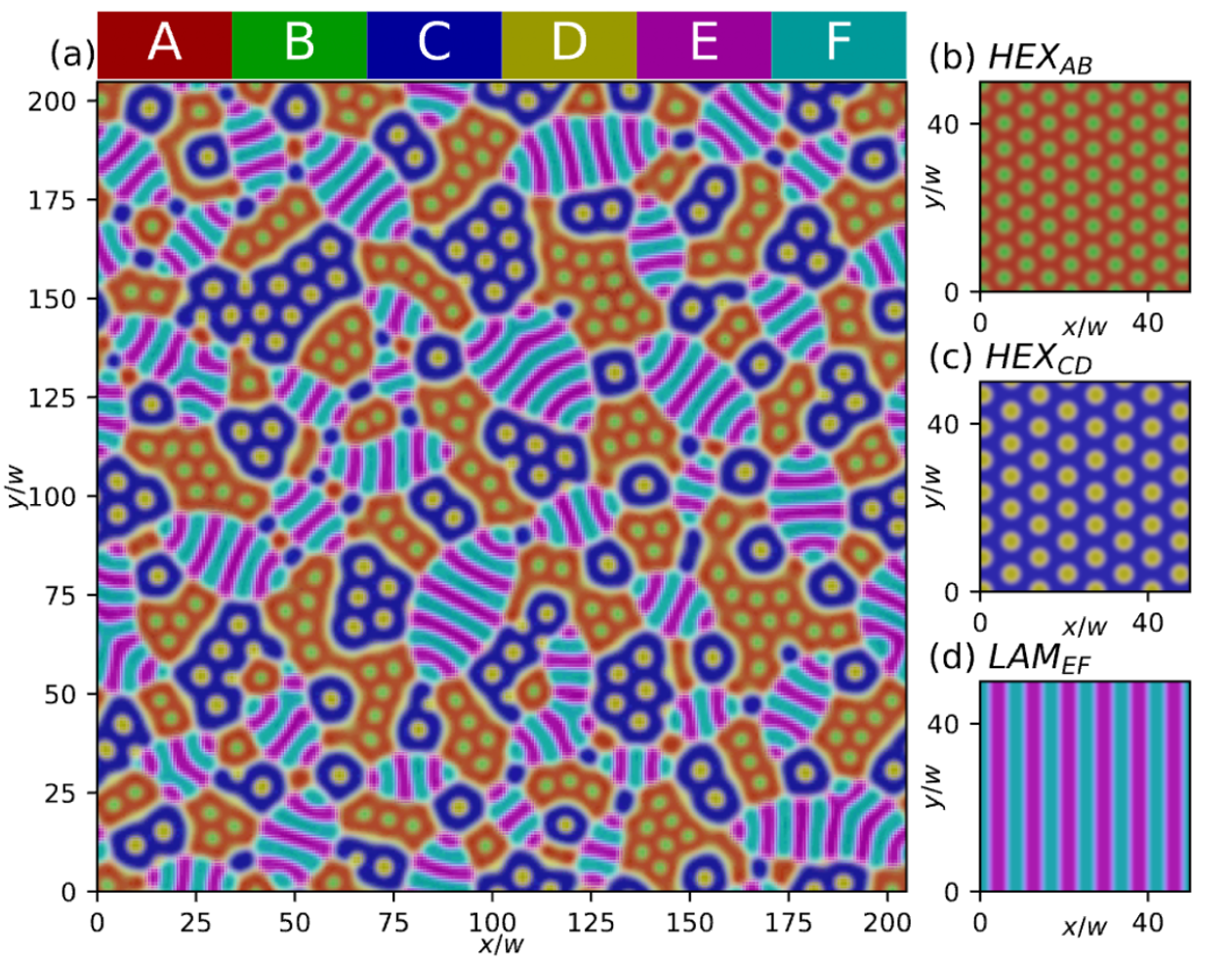
Reaction-diffusion equations give rise to spatially patterned states such as Turing patterns, while short-range physical interactions drive the coexistence of multiple homogeneous phases. What emerges when both mechanisms act simultaneously?
The key insight is that linear reactions at steady state and long-range interactions in equilibrium share the same mathematical structure. This deep analogy allows us to reinterpret complex spatiotemporal patterns as the coexistence of patterned phases, and provides an upper bound on the number of coexisting phases via a generalized Gibbs phase rule.
Glass Transition
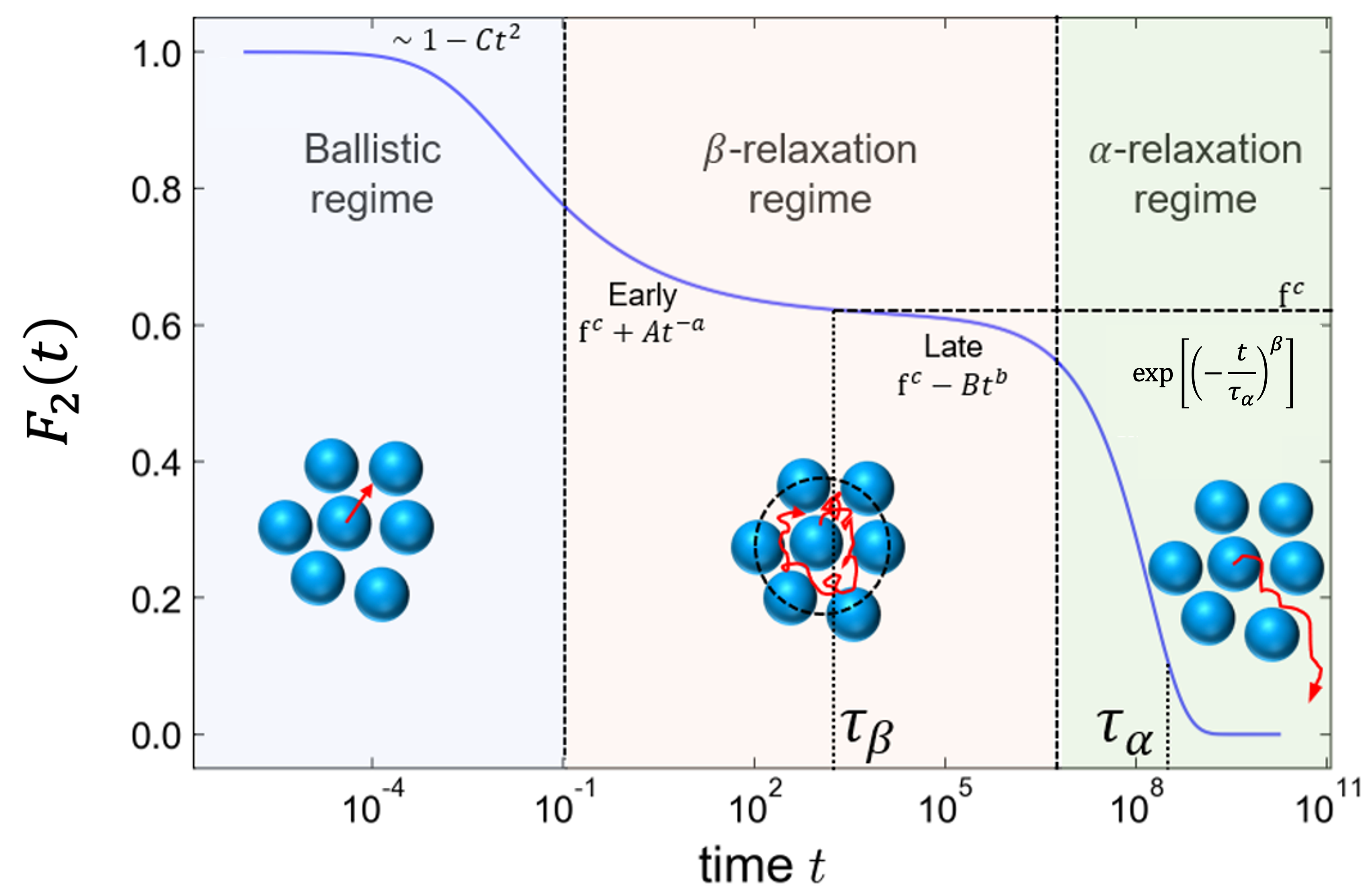
Almost any material can be cooled or compressed from a liquid to a glass state. During this process, the relaxation dynamics slows down by many orders of magnitude, while the disordered microstructure changes only mildly. This apparent disconnect between structure and dynamics lies at the heart of the glass-transition problem and has remained one of the grand challenges in condensed matter physics.
We tackle this challenge by developing first-principles theories that systematically connect the static structure of a material to its dynamical relaxation, providing new insights into the microscopic origin of glassy slowdown.
Generalized mode-coupling theory
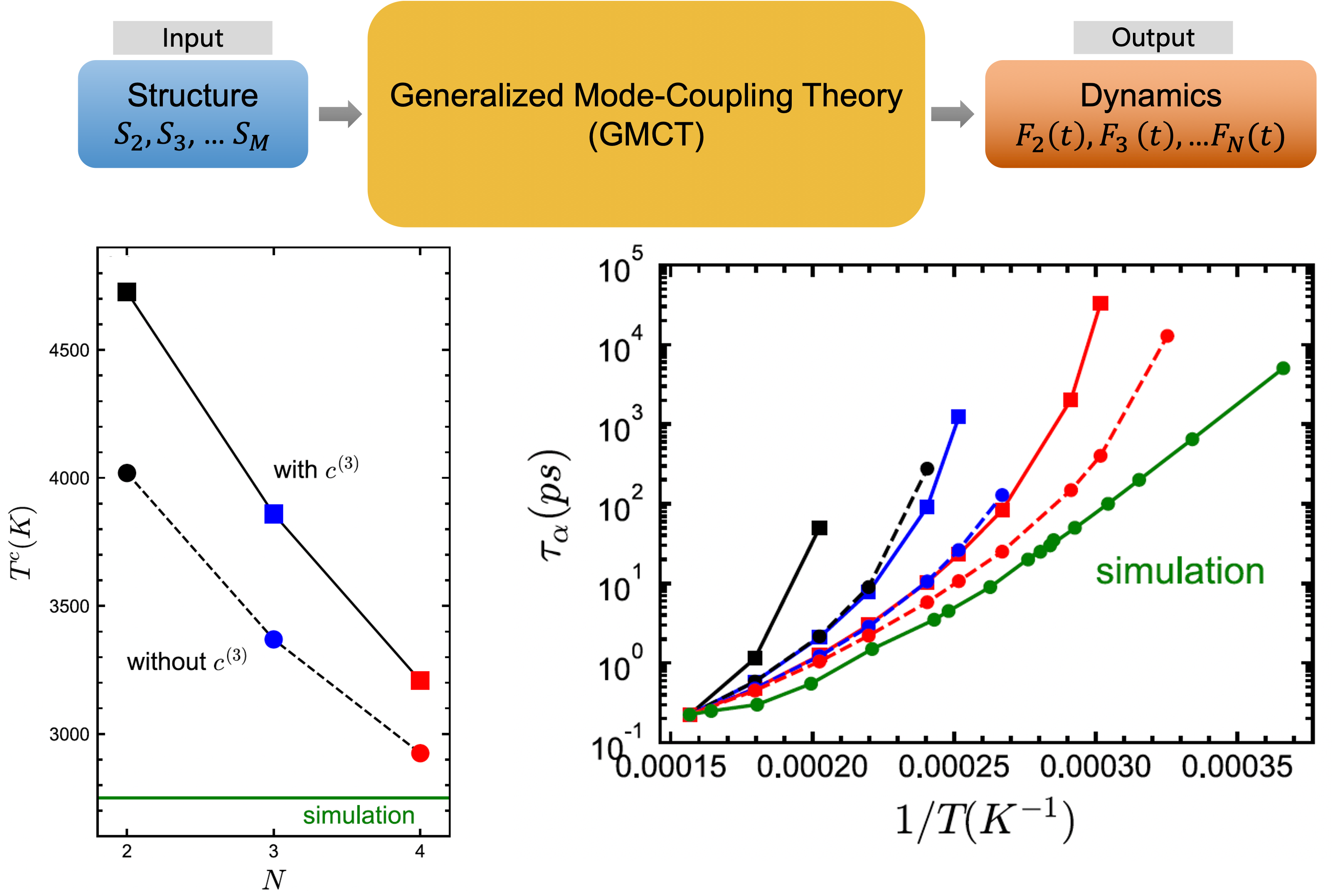
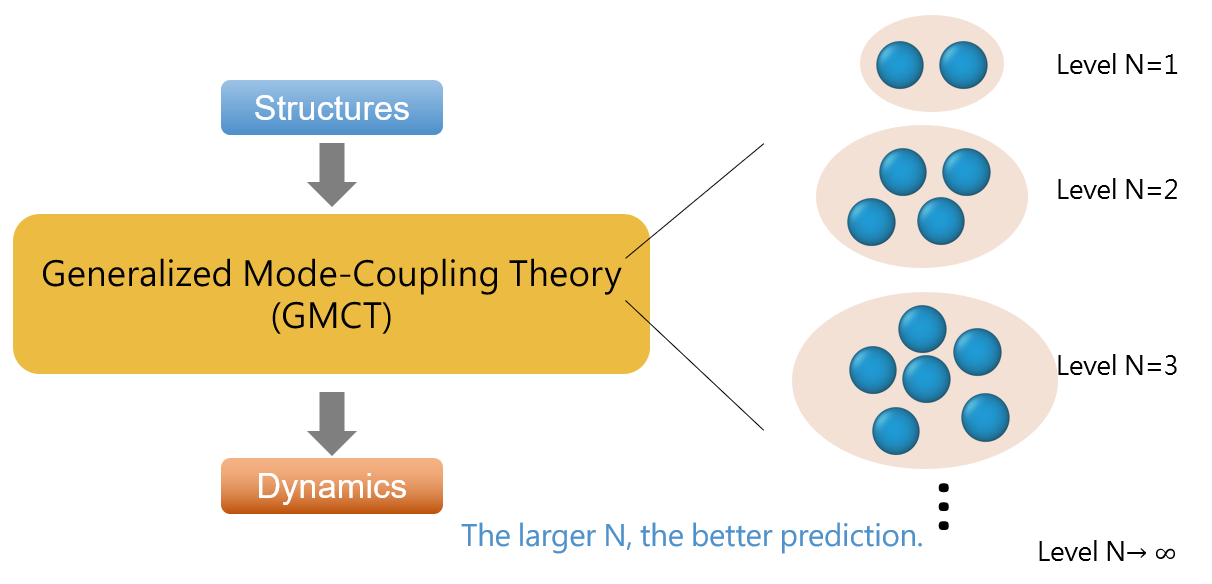
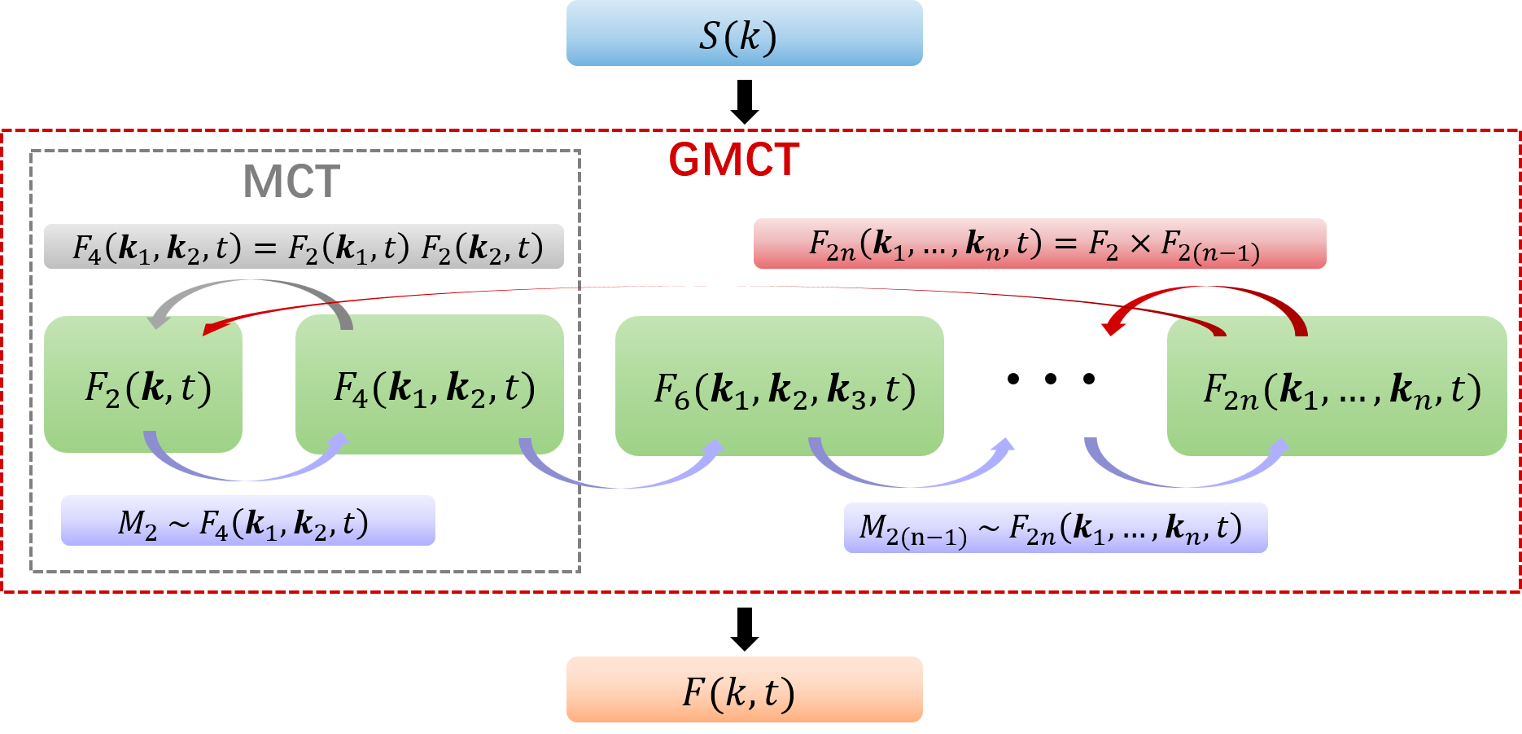
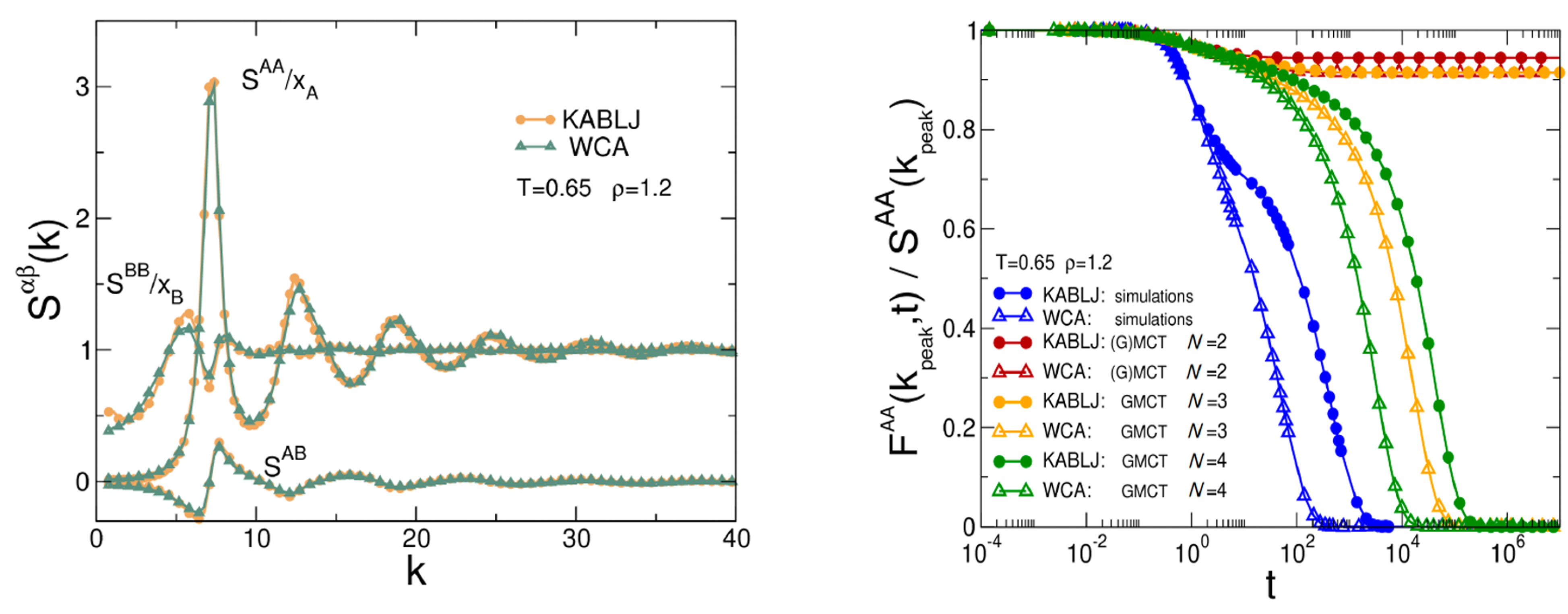
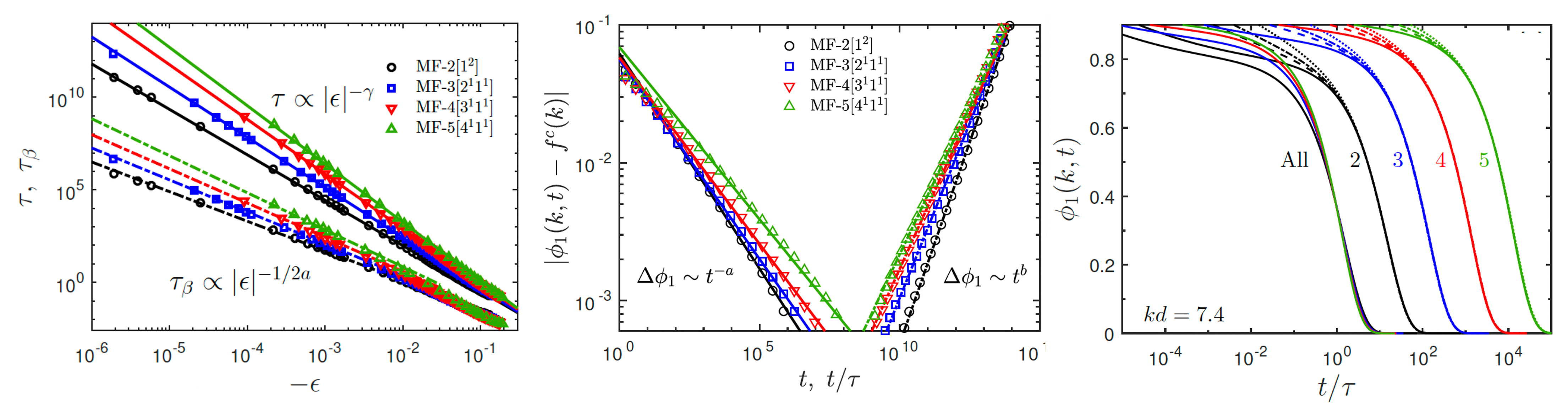
Standard mode-coupling theory (MCT) relates the slow dynamics of supercooled liquids to the static pair structure, but its quantitative predictions are often inaccurate. To go beyond MCT, we have developed a generalized mode-coupling theory (GMCT) that derives, from first principles, the coupled dynamical equations for many-body density correlation functions. These equations form an infinite hierarchy, where each level feeds back into the others through memory kernels. In principle, the theory becomes exact as the closure level approaches infinity; in practice, we truncate at a finite level and systematically improve the predictions by increasing it.
Applying GMCT to glass-forming materials
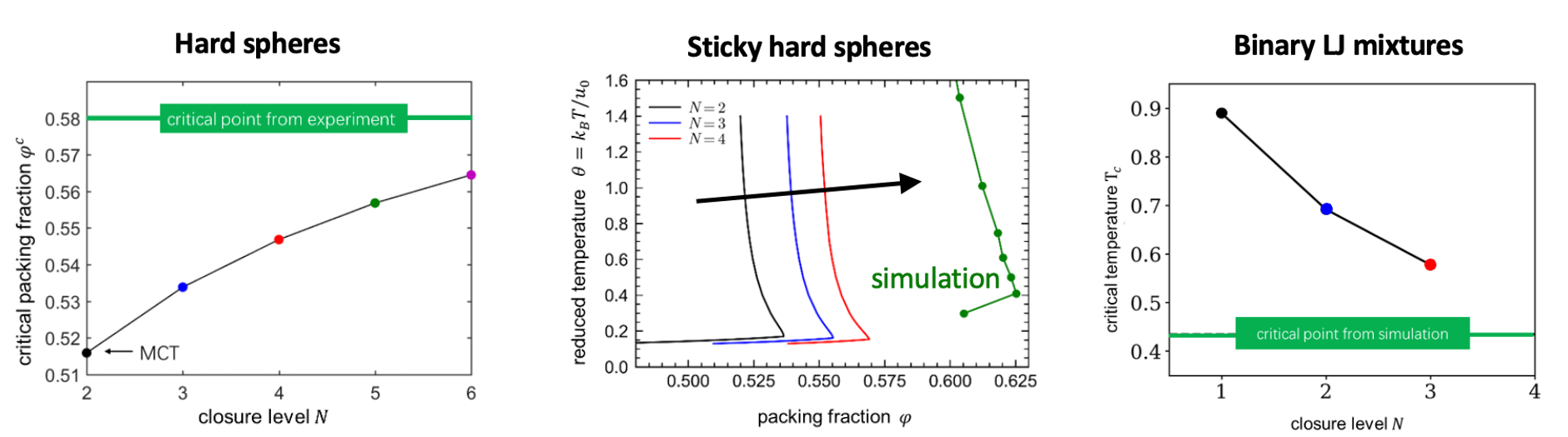
We have applied GMCT to a wide range of glass-forming models, and in every case the predictions improve systematically with increasing closure level.
For hard spheres, GMCT yields progressively more accurate critical packing fractions.
For sticky hard spheres, it not only sharpens the predicted critical temperatures but also captures the re-entrant glass transition behavior.
- Multi-component generalized mode-coupling theory: predicting dynamics from structure in glassy mixtures, The European Physical Journal E 44, 91 (2021)
- Glassy dynamics of sticky hard spheres beyond the mode-coupling regime, Soft Matter 17, 7645--7661 (2021)
- Generalized mode-coupling theory for mixtures of Brownian particles, Physical Review E 104, 065302 (2021)
- Generalized mode-coupling theory of the glass transition. II. Analytical scaling laws, The Journal of Chemical Physics 153, 214506 (2020)
Beyond pair structure: the role of many-body static correlations
Most liquid-state theories rely solely on pair-level structural information, but the dynamics of a glassy system is also shaped by higher-order static correlations. How important are these conventionally neglected contributions?
We further extend our theory to include the contribution of higher-order static correlations. We find that incorporating even the static triplet direct correlations already qualitatively changes the predicted glass-transition diagram of both binary hard-sphere mixtures and the strong network glass-former silica. Strikingly, there is a nontrivial competition: static triplet correlations tend to stabilize the glass state, while higher-order dynamic correlations act to destabilize it. This competition is present in both fragile and strong glass-formers, demonstrating that many-body static correlations are an essential — yet long-overlooked — ingredient for a quantitative theory of the glass transition.